On 17 November 2026, CRIF brought together leaders from finance, trade, technology, and diplomacy at Prada Caffè, ION Orchard for CRIF Forum Singapore 2026. It was our first CRIF Forum in Singapore and the final stop in the CRIF Forum 2026 regional series across Asia.
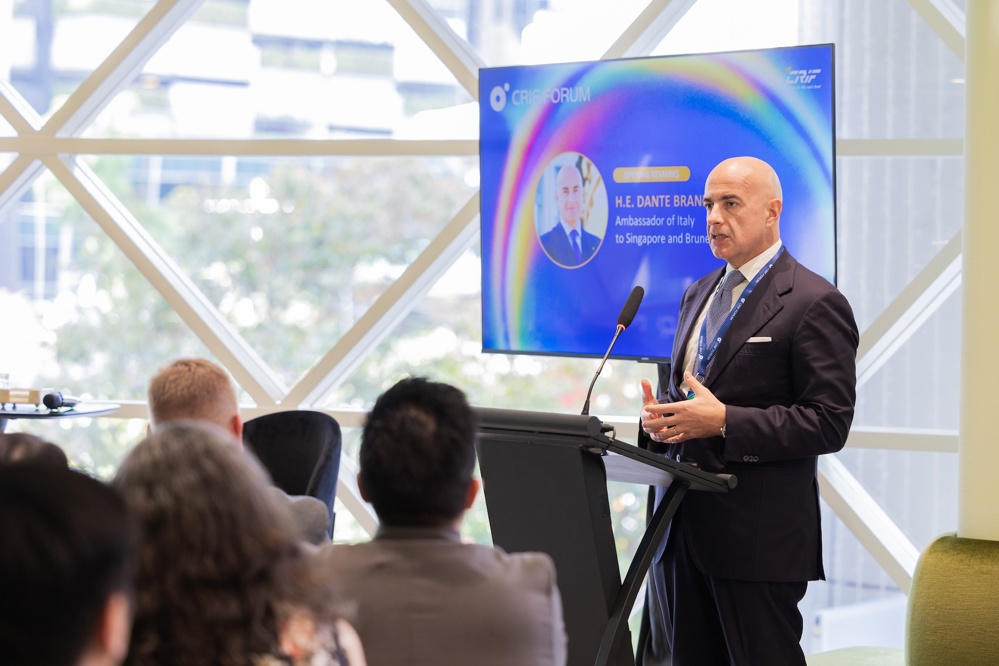
The afternoon opened with special remarks from H.E. Dante Brandi, Ambassador of Italy to Singapore and Brunei, on the investment ties growing between Italy and Singapore. Gabriele Graziani, Country Director, Singapore, CRIF, then welcomed attendees and framed the forum theme: Empowering Growth with Trusted Data. He set the context for the discussion: geopolitical uncertainty, the value of trusted information, and Singapore's upcoming ASEAN chairmanship.
Across the sessions, one idea came through consistently: in a changing Asia, growth goes to the businesses that turn uncertainty into better decisions.

Italy and Singapore: Investment Flowing Both Ways
Ambassador Brandi described a relationship in which investment is now moving in both directions. Examples included Silicon Box's €3 billion semiconductor facility in Novara, a planned K2 Strategic data centre south of Milan, and GIC's activity in Italian private markets.
He pointed to Italy's mid-sized manufacturing companies as natural partners for businesses looking to expand into Asia, and described the work under way toward a formal Italy–Singapore strategic partnership supported by a three-year action plan. CRIF, an Italian company with a strong Asian footprint, was highlighted as an example of how trusted financial information helps businesses make cross-border decisions with confidence.
EU–ASEAN: Confidence Is High, Integration Has to Catch Up
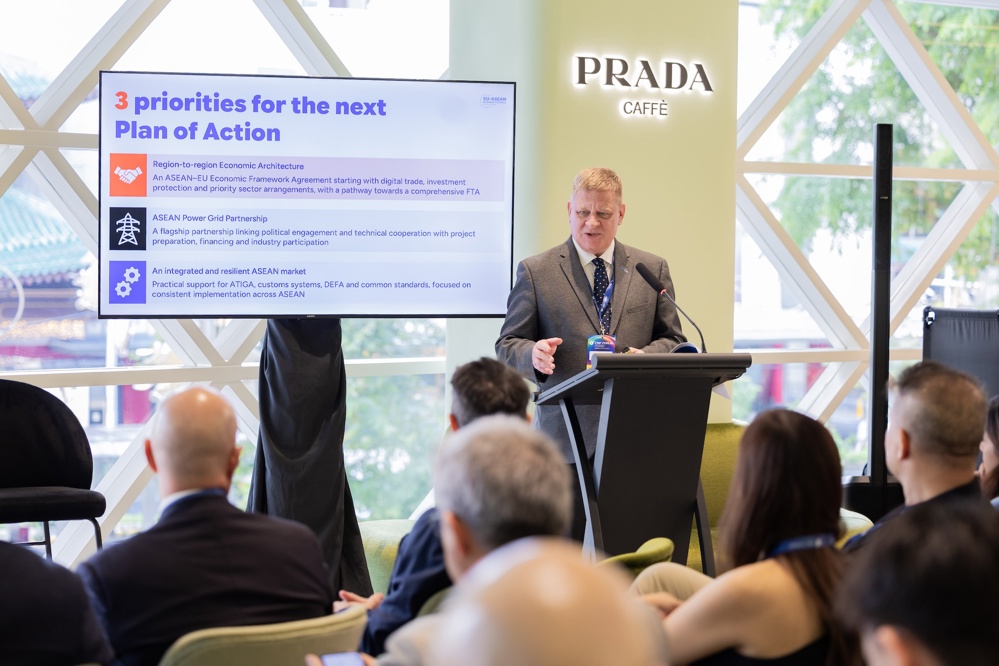
Chris Humphrey, Executive Director of the EU-ASEAN Business Council, delivered the keynote, The Next Growth Horizon: Turning Change into Opportunity, drawing on the Council's business sentiment survey.
The headline from the survey is that European business confidence in Southeast Asia remains strong. 61% of respondents see ASEAN as the region of best economic opportunity, and 78% expect to increase trade and investment there over the next five years. Vietnam and Indonesia stand out as the markets attracting the most growth interest.
Turning that confidence into investment is the harder part. In the same survey, 73% of respondents say there are too many barriers to using ASEAN supply chains efficiently, with regulatory complexity the top pain point, and 83% would use regional supply chains more if those barriers came down. Fragmented standards and uneven market access mean ASEAN does not yet function as the single market businesses need.
Humphrey called for more substantive EU engagement with the region and a modular region-to-region economic framework. Rather than waiting on a comprehensive free trade agreement, that framework could begin with a focused area such as digital trade or investment.
He also looked at ASEAN's digital economy framework, which covers digital trade, electronic payments, digital identity, AI governance, data flows, cybersecurity, and support for smaller businesses. His assessment was balanced. The framework contains useful provisions, but its impact will depend on implementation, particularly where commitments are qualified by existing national laws or soft implementation language.
Finding Growth in a Changing Asia: From Signals to Decisions
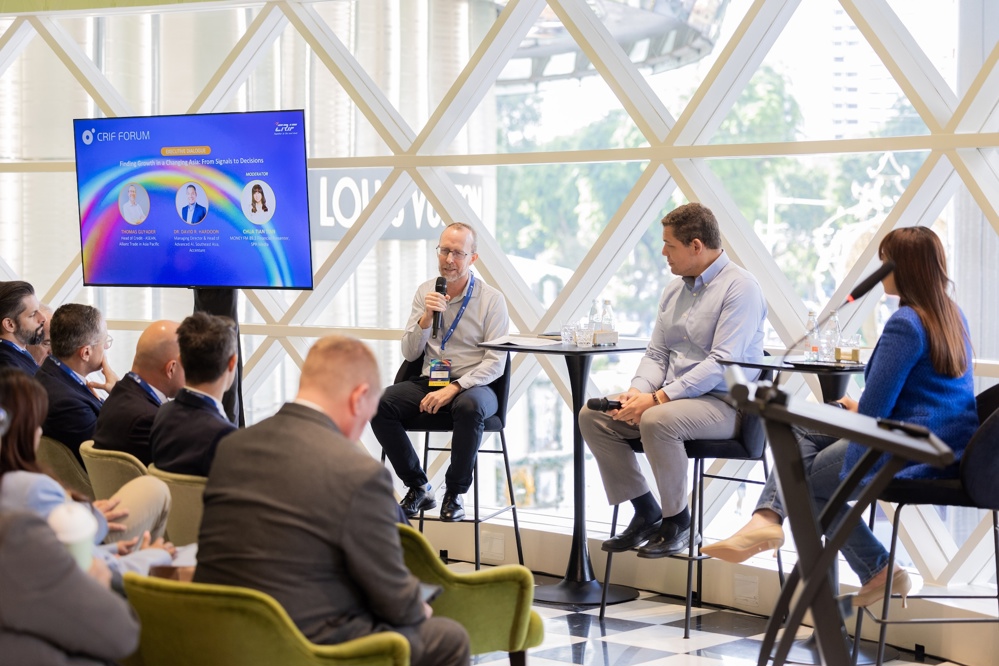
The executive dialogue, moderated by Chua Tian Tian, Financial Presenter, MONEY FM 89.3, SPH Media, brought together Thomas Guyader, Head of Credit – ASEAN, Allianz Trade in Asia Pacific, and Dr. David R. Hardoon, Managing Director and Head of Advanced AI, Southeast Asia, Accenture. The central question: leaders have more information than ever, so how do they know which signals matter, and when they are confident enough to act?
Guyader set out the pressures facing businesses across the region. Geopolitical fragmentation and trade disruption are reshaping supply chains, while inflation and financing costs are squeezing margins in specific sectors and countries. At the same time, AI investment and supply-chain diversification are opening real growth opportunities across APAC.
He made the case for trade credit insurance as more than protection against buyer non-payment. Used well, it is also a credit management tool. The discipline behind it matters most: forward-looking data, thorough due diligence on customers and suppliers, a clear view of measurable business value, and contingency planning for the disruptions that cannot be avoided.
Hardoon turned to AI and its growing role in business decisions. Today's tools are increasingly contextual, but their value depends on practical choices about data quality, localisation, token costs, energy, and resilience. For AI to work in Asia, it has to reflect local context. He also stressed the need for system-level safeguards against unexpected agent behaviour, and for using AI to expand capacity, not only to cut costs.
On investment decisions, Hardoon distinguished between three kinds of value: direct ROI, second-order ROI, and infrastructure-like value that may not fit a conventional ROI calculation at all. His closing advice was simple. Start with a challenge you already know, or a clear business objective, and build from there.
Tian Tian brought the two perspectives together, connecting the commercial realities of trade and credit with the possibilities of AI and data. She closed on a point that ran through the whole afternoon: the right information shapes business outcomes, and due diligence remains as important as ever.
Closing the 2026 Series
Across an afternoon of conversation at Prada Caffè, ION Orchard, a few things became clear.
The opportunity in Asia is real, and so is the uncertainty. Cross-border growth depends on trusted information, regional integration that works in practice, clear visibility into credit risk, and AI applied to defined business problems rather than experiments in search of a purpose.
New technology does not replace the fundamentals. Whether the decision is an investment in Italy, an expansion across ASEAN, or a new trading partner, the businesses that move with confidence are the ones that know who they are dealing with and can trust the information behind every decision.
Thank you to every speaker, moderator, and attendee who made CRIF Forum Singapore 2026 a fitting close to our CRIF Forum 2026 series. Here is to building the trusted data foundation businesses in Singapore and across Asia need to grow.